For some children, finding the cause of a medical condition is not straightforward. Developmental delays, recurrent seizures, muscle weakness, unexplained metabolic abnormalities, and congenital differences can be associated with hundreds of different genetic conditions. Many of these disorders share similar symptoms, making it difficult to identify the underlying cause through clinical examination and routine investigations alone.

Families may consult multiple specialists and undergo numerous tests over several years without receiving a definitive diagnosis. This prolonged search for an explanation is often described as a diagnostic odyssey.
Advances in genomic medicine are changing this experience. Next-generation sequencing (NGS) allows scientists to analyse large amounts of genetic information, helping clinicians identify disease-causing variants that may otherwise remain undetected. For children with suspected genetic disorders, this technology can provide a molecular diagnosis, clarify the cause of their symptoms, and help guide further clinical management.
“A molecular diagnosis can be a turning point for a family that has spent years seeking answers.”
At Genelabs X, genomic sequencing is being applied to paediatric clinical genetics to help bridge the gap between unexplained clinical findings and a more precise diagnosis.
What is next-generation sequencing?
Every individual inherits DNA from their parents. DNA contains genes that provide instructions for the development and functioning of the body. Changes in these instructions, known as genetic variants, can sometimes disrupt normal biological processes and cause disease.
Traditional genetic tests generally examine specific genes or selected regions of DNA. NGS enables the simultaneous analysis of many genes, making it particularly useful when a child's symptoms could be explained by several different genetic conditions.
- Whole-exome sequencing (WES): Examines the exome, which consists of the protein-coding regions of the genome. Although these regions represent only a small proportion of human DNA, they contain many variants responsible for known genetic disorders.
- Whole-genome sequencing (WGS): Examines nearly all of an individual's genomic DNA, including both coding and non-coding regions. Its broader scope can help identify certain genetic changes that may not be detected through WES.
- Blended genome-exome sequencing (BGE): Combines whole-exome sequencing (WES), low-pass whole-genome sequencing, and mitochondrial genome analysis to investigate disease-causing variants across coding regions, genomic regions, and mitochondrial DNA.
The choice of test depends on the child's clinical presentation, the suspected genetic condition, and the limitations of previous investigations. No single test detects every possible genetic cause of disease, but genome-scale sequencing can substantially expand the range of conditions that can be investigated.
“Genomic testing is not simply about identifying DNA changes. It is about understanding what those changes mean for the child.”
What did our study reveal?
To evaluate the clinical utility of genome-scale sequencing in paediatric practice, our team at Genelabs X analysed 100 tests performed in children referred for suspected genetic conditions. The study was presented as an oral presentation at the Asia Pacific Congress of Pediatrics 2026, held at the Bandaranaike Memorial International Conference Hall (BMICH) in Colombo, Sri Lanka, from 26-29 July 2026.
The cohort included 100 children aged from one day to 18 years, comprising 53 males and 47 females. Testing consisted of 90 WES tests, five WGS tests, and five BGE tests.
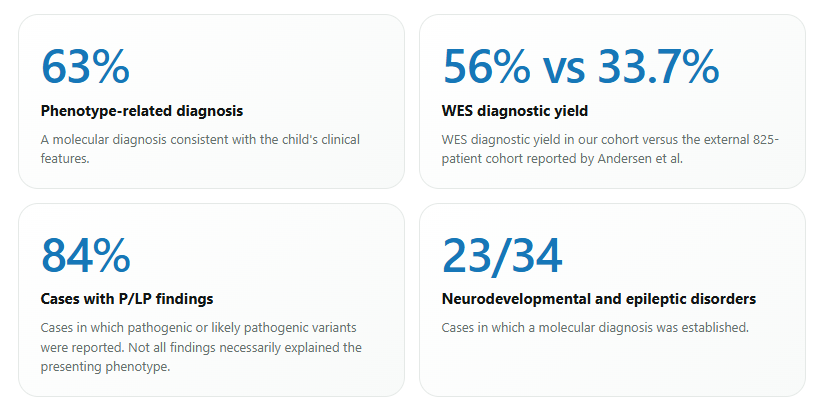
Our cohort achieved a diagnostic yield of 56% with whole-exome sequencing (WES), compared with the 33.7% reported by Andersen et al. in a study of 825 patients undergoing diagnostic WES. This represents a difference of 22.3 percentage points between the reported yields. Although this comparison highlights the diagnostic potential of WES in our Sri Lankan paediatric cohort, the findings should be interpreted cautiously because the studies may differ in patient selection, clinical indications, and diagnostic criteria.
These findings demonstrate the value of genomic sequencing across a broad range of paediatric indications, particularly when clinical features overlap between different genetic conditions.
Interpreting the findings: These diagnostic yields reflect this particular referral cohort and should not be interpreted as guaranteed outcomes for every child undergoing genomic testing.
Diagnostic yield across clinical groups
The highest diagnostic yield was observed in neuromuscular and peripheral nervous system disorders (9 of 12 cases, 75%), followed by neurodevelopmental and epileptic disorders (23 of 34 cases, 67.6%) and metabolic and endocrine disorders (11 of 17 cases, 64.7%).
How can a genetic diagnosis change a child's care?
Identifying a genetic variant is only one part of the diagnostic process. Its clinical significance depends on the gene involved, the nature of the variant, the associated disease, the child's symptoms, and the available scientific evidence.
Providing an explanation for previously unexplained symptoms
A genetic diagnosis can connect clinical findings that initially appear unrelated. For example, developmental delay, seizures, abnormal muscle tone, and distinctive physical features may be manifestations of a single underlying genetic disorder. Establishing this connection can help families and clinicians better understand the condition and avoid further investigations that are unlikely to provide additional answers.
Supporting more targeted clinical management
For some genetic conditions, establishing the underlying cause can influence treatment choices, surveillance, and preventive care. Certain diagnoses may indicate the need to monitor specific organs, assess the risk of particular complications, or refer the child to an appropriate specialist. In selected conditions, a molecular diagnosis can also identify eligibility for disease-specific treatments. However, the clinical benefit depends on the particular disorder, and a genetic diagnosis does not automatically mean that a targeted treatment is available.
Informing prognosis and follow-up
A confirmed diagnosis may provide information about the expected course of a condition, its potential complications, and the investigations required during follow-up. Although the clinical course can vary considerably between individuals with the same genetic disorder, this information can help healthcare professionals develop a more informed and individualised care plan.
Helping families understand inherited risks
Genomic results can provide important information about how a condition may have arisen and whether other family members could be affected or carry a relevant genetic variant. Genetic counselling can help families understand recurrence risks, the implications for siblings and future pregnancies, and the available reproductive options.
Why do some children remain undiagnosed?
Although genomic sequencing has transformed rare-disease diagnosis, a negative result does not necessarily exclude a genetic condition.
“A negative result does not necessarily exclude a genetic condition.”
Some variants are difficult to detect or interpret. Others may lie in regions that are not adequately covered by a particular test, involve complex structural changes, or affect gene regulation in ways that are not yet fully understood. In addition, scientific knowledge of rare diseases and their associated genes continues to evolve.
The analysis of our cohort demonstrated the complementary role of WES and WGS. WGS achieved a diagnostic yield of 100% among the five cases tested and identified a clinically relevant copy-number variant (CNV) that had not been detected by WES. Copy-number variants are genetic changes involving the deletion or duplication of sections of DNA.
This finding illustrates how broader genomic analysis can provide additional information in selected cases. However, because only five WGS tests were included in the study, this result should be interpreted cautiously and does not establish that WGS will have a 100% diagnostic yield in routine clinical practice.
For children whose initial investigations are inconclusive, further analysis, additional testing, or future reanalysis of existing genomic data may help establish a diagnosis as scientific knowledge advances.
Understanding the difference between a genetic finding and a diagnosis
Not every genetic variant identified through sequencing explains a child's symptoms. Some variants are classified as pathogenic or likely pathogenic but are unrelated to the reason for referral. Others may indicate that a child is a carrier of a recessive condition without having that condition. Occasionally, testing identifies a finding with potential implications for health beyond the original clinical indication.
This distinction is essential when interpreting genomic results. A clinically meaningful diagnosis requires the genetic findings to be assessed in the context of the child's phenotype, inheritance pattern, family history, and established scientific evidence.
In our study, 21% of cases were reported to have incidental or carrier-only findings, while 16% had negative results. These findings highlight the importance of careful interpretation and appropriate communication of results, including a clear explanation of what a finding does and does not mean for the child and family.
Genomic testing is therefore not simply a process of identifying DNA changes. It requires the integration of laboratory data, bioinformatics, clinical genetics, and evidence-based variant interpretation.
Advancing paediatric genomic medicine in Sri Lanka
Rare genetic disorders can present significant diagnostic challenges for children and their families. Improving access to appropriate genomic investigations and strengthening local expertise in genomic data analysis are important steps towards more precise and informed clinical care.
Our 100-case study demonstrates the potential of genome-scale sequencing in a Sri Lankan paediatric referral cohort. The findings support its use across a range of clinical indications, particularly in children with neurodevelopmental disorders, epilepsy, metabolic conditions, and neuromuscular presentations.
The study also highlights the importance of selecting the appropriate sequencing strategy, interpreting results in their clinical context, and recognising the limitations of current testing technologies.
Looking ahead: From genetic information to meaningful clinical answers
A molecular diagnosis can represent a turning point for a family that has spent years seeking an explanation for a child's condition. It may help clarify the cause of the illness, guide clinical surveillance, inform family counselling, and provide a clearer path for future care.
At Genelabs X, our work in clinical genomics is focused on translating complex genetic data into scientifically supported findings that can contribute to patient care.
Although genomic sequencing cannot answer every clinical question, it offers an increasingly powerful approach to understanding rare paediatric disorders. By combining advanced sequencing technologies with rigorous bioinformatics and clinical interpretation, we can move closer to a future in which more children receive timely, accurate, and meaningful genetic diagnoses.
Studies
Our study: Liyanaarachchi D.C., Kumara W.T.G.C.R., Sundralingam T., Punchihewa C., and Subasinghe V. Clinical Utility of Next-Generation Genomic Sequencing in Paediatric Clinical Genetics: A Cohort of 100 Cases. Oral presentation at the Asia Pacific Congress of Pediatrics 2026, Colombo, Sri Lanka, 26–29 July 2026.
Study used for comparison: Andersen PF, Ek J, Karstensen HG, et al. Diagnostic yield of whole exome sequencing in a cohort of 825 patients. European Journal of Medical Genetics. 2025;78:105043. https://doi.org/10.1016/j.ejmg.2025.105043

Written by
Damitha Liyanaarachchi
Bioinformatics Scientist